Convenience and grocery retailers have an opportunity to attract customers through expanded financial services, but making those services available is only the first step.
Convenience stores and grocery stores have steadily expanded their roles in the communities they serve. Beyond providing fuel, food, and household essentials, many now offer services that help customers manage everyday financial needs. ATMs, bill payment, prepaid mobile phone refills, digital gift cards, and money orders can make a familiar retail location an even more convenient destination.
For store operators, these services offer the potential to generate additional transactions, encourage repeat visits, and introduce new customers to their businesses. However, the availability of a service does not guarantee that customers will use it. Consumers who are unaware that a store offers bill payment or mobile top-ups have little reason to change their existing habits, regardless of how conveniently the services are located.
That distinction deserves particular attention as retailers evaluate investments in expanded financial services. Recent research confirms that Americans continue to use cash and rely on a variety of payment methods, while consumer demand for certain alternative financial services remains significant. Turning those needs into customer traffic requires retailers to communicate what they offer and give consumers a reason to choose their locations.
Cash Remains Relevant in American Retail
Despite the continued growth of digital payments, cash remains an important part of the U.S. payment landscape. The Federal Reserve's 2026 Diary of Consumer Payment Choice reports that cash accounted for 14% of consumer payments in 2025. Approximately four out of five consumers had used cash within the previous 30 days, and 90% indicated they planned to continue using it.
Cash usage is particularly relevant to convenience retailers. According to NACS, cash represented 17.5% of transacted convenience store sales in 2025. While card payments account for the majority of transactions, cash continues to serve a meaningful portion of customers.
Payment preferences also differ across demographic and geographic groups. The Federal Reserve found that rural consumers averaged nine cash payments per month, compared with six among suburban and urban residents. Income, age, access to banking services, and personal preferences can also influence how consumers choose to pay.
Grocery retailers face similar considerations, although their payment mix differs from that of convenience stores. Research from PYMNTS published in 2025 found that debit cards were used for 44.1% of consumers' most recent grocery purchases, compared with 26.3% for credit cards. These findings reinforce the importance of accommodating different payment preferences rather than assuming customers have moved entirely toward digital transactions.
For retailers considering expanded financial services, the relevance of cash extends beyond withdrawals. Customers may need to convert physical cash into payments, purchase prepaid products, or complete transactions that would otherwise require a separate trip.

Consumer Financial Needs Extend Beyond the ATM
While ATMs remain an important convenience for shoppers, consumers have financial needs that extend beyond cash withdrawals. Services such as bill payment, digital gift cards, mobile top-ups, and money orders can provide additional reasons to visit convenience and grocery stores, particularly when customers can complete financial transactions alongside their regular shopping.
Research supports the continued relevance of these services. The Federal Reserve's 2026 Economic Well-Being of U.S. Households report found that 12% of adults used nonbank check-cashing or money-order services in 2025. The FDIC also found that 8% of U.S. households used nonbank money orders in 2023. Meanwhile, Blackhawk Network's June 2026 research revealed that 77% of consumers planned to purchase gift cards during the year, with 56% planning to purchase them for personal use as a spending strategy.
For retailers, these services can create opportunities to attract new customers and encourage repeat visits. Bill payments and prepaid mobile refills address recurring needs, while gift cards and money orders serve specific purchasing and payment purposes. However, even services with established consumer demand may go unused when customers don't realize they're available at a nearby store.
That makes customer awareness just as important as the services themselves.
Why Adding Services Doesn't Automatically Increase Traffic
The business case for expanded financial services often includes the expectation of additional customer visits. That expectation is reasonable, but it depends on consumers knowing which services are available and understanding how to access them.
Consider a convenience store that installs a multifunction financial kiosk near its entrance. Customers may walk past the equipment several times a week without realizing it offers anything beyond cash withdrawals. Even those who notice the machine may not know whether it supports bill payment, mobile refills, or gift card purchases.
Meanwhile, those same customers may continue visiting other businesses to complete transactions they could have handled during their regular shopping trips.
This creates a marketing challenge, as much as an operational one. Retailers must identify which services are most relevant to their customers, communicate those offerings clearly, and make the experience straightforward enough to encourage repeat usage.
National consumer demand can help establish the potential market, but local awareness and adoption ultimately determine whether the investment contributes to store performance.
Strategies for Promoting Retail Financial Services
Retailers do not necessarily need extensive advertising budgets to introduce in-store financial services to their customers. Existing signage, digital communications, employee interactions, and customer relationships can provide effective starting points.
The following strategies can help store operators incorporate financial services into their broader marketing efforts.
1. Use Exterior Signage to Attract Customers Before They Enter
Exterior signage allows retailers to reach customers before they make a decision about where to stop. Window graphics, entrance signs, and fuel-pump advertising can introduce financial services to people who may not otherwise associate the location with bill payment, mobile top-ups, or money orders.
Messages should identify specific services rather than relying entirely on the name or branding of the equipment. For example, a sign advertising bill payment communicates a practical benefit more clearly than one promoting a financial-services kiosk.
Retailers should prioritize the services most likely to resonate with their customer base and ensure that every advertised transaction is available at that location.
2. Incorporate Financial Services Into Existing In-Store Advertising
Once customers enter the store, point-of-sale materials can reinforce the services advertised outside. Countertop displays, checkout signage, digital screens, and graphics positioned near the equipment can introduce offerings without interfering with normal store operations.
Placement matters because customers may not recognize the purpose of a machine from its appearance alone. Signage near checkout areas can be especially useful when it connects a service to a familiar customer need, such as paying a utility bill or replenishing a prepaid wireless account.
Rather than attempting to advertise every feature simultaneously, retailers can rotate messages throughout the year. This keeps communications focused and allows operators to evaluate which services generate the most interest.
3. Promote Services Through Social Media, Websites, and Loyalty Programs
Digital communications can reach customers before they arrive at a store. This is particularly relevant in grocery retail, where consumers frequently research products, compare prices, and plan shopping trips using digital resources.
FMI's 2026 U.S. Grocery Shopper Trends research found that 77% of grocery shoppers engage with digital resources before shopping, while 71% use digital tools during their shopping trips.
Retailers can use these established communication channels to promote financial services alongside traditional merchandise and store announcements. A grocery retailer might include bill-payment availability in its customer newsletter, while a convenience store could use social media to remind customers that prepaid phone refills are available.
Loyalty programs may offer additional opportunities to reach existing shoppers. Where supported by the program, retailers can introduce financial services through app notifications, email campaigns, or other communications that customers have agreed to receive.
4. Help Customers Find Services Through Local Search
Consumers frequently use online searches to find nearby businesses that offer a particular product or service. Retailers offering financial services should make that information accessible through their websites and business listings.
Service pages can identify participating locations, available transactions, business hours, fees, and relevant requirements. Including accurate location-specific information helps customers determine whether a store can meet their needs before making the trip.
Retailers can also review their Google Business Profiles and other local listings to ensure their descriptions reflect available services where permitted by the platform.
This approach is particularly relevant for services that customers actively seek out, such as money orders and bill payment. A consumer searching for a nearby payment location may be more motivated to visit than someone who encounters a general advertisement.
5. Make Employees Part of the Awareness Effort
Store employees interact with customers who may already have a need for financial services. Providing employees with basic information about available transactions can help bridge the gap between installing equipment and building awareness.
Employees should understand which services are offered, where customers can access them, and who to contact when a transaction requires assistance. In some situations, a brief mention during checkout may be enough to introduce a service a customer did not know was available.
Training should emphasize accurate information and helpful customer service rather than aggressive promotion. Employees do not need to become financial-services specialists, but they should be able to direct customers to the equipment and explain where to find additional information.
6. Coordinate Promotions with Consumer Purchasing Patterns
Financial services can be marketed more effectively when promotions reflect how and when customers are likely to use them.
Bill-payment messaging may be useful throughout the month, while digital gift card promotions can become more prominent around holidays, graduations, and other gifting occasions. Prepaid mobile top-ups may benefit from consistent year-round visibility because customers can need them at any time.
Retailers should use their own transaction data and customer feedback to refine promotional timing. National trends provide general direction, but they may not accurately reflect the purchasing patterns of every neighborhood or store.
When appropriate, retailers can also coordinate financial-service messaging with existing merchandise promotions. This helps integrate the services into the overall shopping experience rather than presenting them as an unrelated offering.
7. Measure Performance and Adjust Marketing Efforts
Expanded financial services should be evaluated with the same attention retailers apply to other products and services. Transaction counts, service-specific activity, and repeat usage can provide useful information about customer adoption.
Operators can compare transaction activity before and after installing signage, launching an email campaign, or introducing employee awareness efforts. These comparisons may help identify effective promotions, although changes in transaction volume can also result from seasonality and other factors.
Where data is available, retailers can examine whether financial-service users make additional purchases during their visits. They should also consider whether the services attract new customers, encourage existing customers to return more often, or primarily provide added convenience during visits that would have occurred anyway.
Understanding these differences can help operators make better decisions about future marketing investments and service expansion.
Turning Financial Services Into a Retail Advantage
Financial services have the potential to strengthen the role convenience and grocery stores play in their communities. By offering additional ways to pay bills, purchase prepaid products, access cash, and complete other financial transactions, retailers can make their locations useful for more than traditional shopping.
These services can also support broader business objectives. Customers who visit to complete financial transactions may purchase other merchandise, and recurring services can provide additional opportunities to build long-term relationships.
However, retailers should not assume that these outcomes will occur simply because the equipment is available. Consumer needs, local competition, service selection, marketing, and the customer experience all influence results.
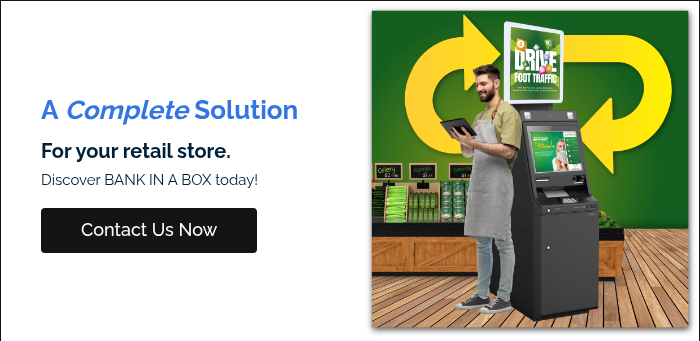
Cash Depot's BANK IN A BOX provides retailers with intelligent cash management capabilities and access to supported consumer financial services, helping bring everyday financial transactions into the retail environment. When paired with effective communication and promotion, these capabilities can give customers additional reasons to choose a participating location.
The most successful retailers will approach expanded financial services as an ongoing part of their business rather than a one-time equipment installation. By identifying relevant customer needs, promoting available services, and measuring adoption, store operators can make more informed decisions about how to turn convenience into customer traffic.